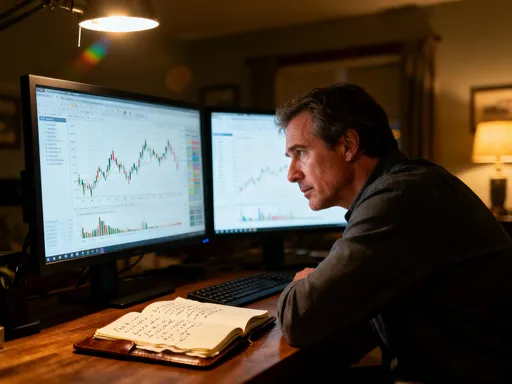
How I Stopped Gambling on Investments and Started Building Real Wealth
What if the biggest threat to your financial freedom isn’t the market, but you? I used to chase “hot” opportunities, thinking risk meant reward. Then I lost more than I made. That’s when I realized: true financial freedom starts with honest risk assessment. It’s not about avoiding risk—it’s about knowing which risks are worth taking. This is how I rebuilt my strategy, stayed in control, and finally gained real momentum. My journey wasn’t marked by sudden windfalls or viral stock picks. Instead, it was shaped by discipline, reflection, and a growing understanding of what real investing looks like. The shift didn’t happen overnight, but once I stopped reacting to market noise and started building a thoughtful, risk-aware approach, my financial life changed in ways I hadn’t imagined possible.
The Wake-Up Call: When My Portfolio Crashed (And My Confidence With It)
There was a time when I believed that confidence and speed were the keys to investment success. I would read a headline, feel a surge of optimism, and within hours, put thousands into a trending stock or a new fund. I told myself I was being bold, forward-thinking, and in control. But in reality, I was operating on emotion, not strategy. I wasn’t analyzing financial statements, evaluating company leadership, or considering long-term trends. I was reacting—quickly, impulsively, and without a safety net. The turning point came during a sharp market correction. What started as a minor dip quickly turned into a 30% drop in my portfolio value over just six weeks. I watched helplessly as gains I’d celebrated months earlier vanished, not because of a company’s failure, but because of a broader economic shift I hadn’t anticipated.
The financial loss was painful, but the emotional toll was deeper. I felt embarrassed, frustrated, and, most of all, out of control. I had believed I was building wealth, but in truth, I was gambling with my future. That moment forced me to confront a difficult truth: I didn’t understand risk. I had confused volatility with opportunity, and excitement with expertise. The crash wasn’t just a market event—it was a personal reckoning. I began to ask myself hard questions. What assumptions had I been making? Why had I ignored warning signs? And most importantly, what kind of investor did I actually want to be? That period of reflection marked the beginning of a fundamental shift. I realized that real financial strength doesn’t come from chasing the next big thing—it comes from knowing your limits, respecting uncertainty, and making decisions based on knowledge, not hope.
This experience taught me that confidence without competence is dangerous. It also revealed how easily emotion can override logic when money is involved. The desire to win, to prove oneself, or to keep up with others can cloud judgment. I had fallen into the trap of thinking that if I wasn’t taking big risks, I wasn’t doing enough. But the truth is, sustainable wealth isn’t built in moments of adrenaline—it’s built in moments of quiet discipline. Recognizing that my behavior was more speculation than investment was humbling, but it was also liberating. It gave me permission to slow down, to learn, and to rebuild from a foundation of clarity rather than fear.
Risk vs. Reward: Why Most People Get It Backwards
One of the most common misconceptions in personal finance is that high risk always leads to high reward. This belief is deeply ingrained in popular culture—stories of overnight millionaires, tech startups that exploded in value, or investors who “got in early” on the next big thing. These narratives are compelling, but they’re also misleading. They highlight the winners while ignoring the far greater number of people who took similar risks and lost everything. The reality is that the most successful investors aren’t the ones taking the biggest gambles. They’re the ones who understand how to manage risk effectively while still positioning themselves for growth. True financial progress comes not from seeking danger, but from minimizing unnecessary exposure while maximizing informed decisions.
Consider two investors: one who puts all their savings into a single cryptocurrency based on social media hype, and another who spreads their investments across a mix of index funds, bonds, and dividend-paying stocks. The first investor may experience a surge in value if the market moves in their favor, but they’re also vulnerable to sudden collapse. The second investor may not see explosive gains in a single year, but their portfolio is far more resilient. Over time, the consistent, measured approach often outperforms the volatile one, not because it’s riskier, but because it’s more sustainable. This is the essence of strategic risk-taking: accepting some uncertainty in pursuit of growth, but doing so in a way that protects the core of your financial foundation.
Another reason people get risk and reward backwards is the way success stories are told. We hear about the person who sold their house to invest in Bitcoin and became a millionaire, but we rarely hear about the thousands who did the same and ended up in financial ruin. This creates a distorted perception of what’s possible and normal. In reality, long-term wealth is rarely the result of a single bold move. It’s the result of repeated, thoughtful choices—saving consistently, reinvesting dividends, avoiding emotional decisions, and adjusting course based on changing circumstances. These actions don’t make headlines, but they build lasting security.
Understanding this distinction changed my entire approach. I stopped looking for “the next big thing” and started focusing on what I could control: my behavior, my time horizon, and my exposure to different types of risk. I learned that the goal isn’t to eliminate risk—that’s impossible. The goal is to align risk with purpose. If you’re saving for retirement in 30 years, you can afford to take on more market exposure than someone preparing to buy a home in two years. If you’re supporting a family, reckless bets are harder to justify. By reframing risk as a tool to be managed rather than a hurdle to be overcome, I began to make smarter, calmer decisions. The market stopped feeling like a casino and started feeling like a long-term partner in building stability.
Mapping Your Risk Tolerance: It’s Not Just About Money
Risk tolerance is often presented as a simple questionnaire—“How would you react to a 20% market drop?”—with a score that tells you whether you’re conservative, moderate, or aggressive. But in real life, risk tolerance is far more complex. It’s shaped by your personality, your life stage, your financial responsibilities, and your emotional resilience. I learned this the hard way. On paper, I scored as “aggressive” on risk assessments. But when the market actually dropped, I panicked. I sold positions I should have held, missed recoveries, and broke my own rules. That disconnect between my theoretical tolerance and my actual behavior was a red flag. It showed me that risk tolerance isn’t just about numbers—it’s about how you feel when real money is on the line.
To build a more accurate picture of my risk tolerance, I started asking myself deeper questions. How much volatility can I handle without losing sleep? What would happen to my family if my portfolio lost 25% in a year? Am I investing for growth, income, or preservation? These aren’t just financial questions—they’re emotional and practical ones. I also considered my timeline. I realized that even though I was decades from retirement, I didn’t want to endure extreme swings just for the chance of higher returns. My peace of mind mattered as much as my portfolio balance. This led me to redefine what “risk” meant to me. It wasn’t just the chance of losing money—it was the chance of making decisions I’d regret under pressure.
Another important factor was my income stability. As someone with a steady job and no major debts, I could afford to take on more market risk than someone living paycheck to paycheck. But that didn’t mean I should. I began to see risk tolerance as a personal compass, not a one-size-fits-all formula. It had to reflect not just my financial capacity, but my psychological readiness. I also recognized that risk tolerance can change over time. A young professional with few responsibilities might be comfortable with aggressive investments. A parent with college savings to fund might need a more balanced approach. A retiree relying on investments for income has different needs altogether. By acknowledging these shifts, I could adjust my strategy in a way that felt honest and sustainable.
Building this personal risk profile didn’t happen in a day. It required journaling, reflection, and honest conversations with myself. I started tracking how I felt during market changes, not just what my account balance said. I noticed patterns—when I was stressed at work, I was more likely to make impulsive moves. When I felt secure, I could stay the course. This self-awareness became a powerful tool. It didn’t eliminate risk, but it helped me prepare for it. I stopped trying to be someone I wasn’t—an ultra-aggressive trader—and started building a strategy that fit who I actually was: someone who values stability, growth, and peace of mind in equal measure.
The Hidden Risks No One Talks About (But Everyone Faces)
When most people think of investment risk, they picture market crashes, stock plunges, or economic recessions. These are visible, dramatic, and easy to identify. But some of the most damaging risks are invisible—quiet, slow-moving forces that erode value over time without making headlines. I ignored these for years, focusing only on the big, scary events. But in hindsight, the hidden risks did more long-term harm than any single market drop. One of the most insidious is inflation. Even at a modest 3% annual rate, inflation can cut purchasing power in half over 25 years. I had money in savings accounts earning 1% or less—safe, but losing ground every year. I wasn’t losing money in dollars, but I was losing it in real terms. That’s a risk many overlook because it doesn’t show up as a red number on a screen.
Another hidden risk is lack of diversification. I once had over 60% of my portfolio in a single sector because I believed in its long-term potential. When that sector faced regulatory challenges, my entire portfolio suffered. Diversification isn’t just about owning different stocks—it’s about spreading exposure across asset classes, industries, and geographies. Without it, you’re vulnerable to concentrated shocks. Yet many investors, especially those starting out, don’t realize how undiversified they are until it’s too late. Emotional fatigue is another quiet threat. Investing isn’t a set-it-and-forget-it activity, but constantly monitoring the market, reacting to news, and second-guessing decisions can lead to burnout. I reached a point where checking my portfolio felt stressful, not empowering. That mental exhaustion made me more prone to mistakes—selling low, buying high, or abandoning my strategy altogether.
Overconfidence is another dangerous but invisible risk. After a few good years, I began to believe I had a “knack” for picking winners. I stopped doing research, relied on gut feelings, and took on more leverage. That overconfidence set me up for failure. It’s easy to confuse a rising market with personal skill, but when conditions change, the truth becomes clear. Similarly, liquidity risk—being unable to access your money when you need it—can create serious problems. I once locked money into a long-term investment, only to face an unexpected home repair. I had to sell other assets at a loss to cover the cost. That taught me the importance of balancing long-term goals with short-term flexibility.
Recognizing these hidden risks changed how I plan and invest. I now build buffers into my strategy—emergency funds, income-producing assets, and clear withdrawal rules. I review my diversification regularly and adjust as needed. I also schedule “quiet periods” where I don’t check my portfolio, to avoid emotional decision-making. These steps don’t eliminate risk, but they make it visible, manageable, and part of the plan rather than a surprise. By shining a light on what most people ignore, I’ve built a more resilient financial life—one that can withstand not just market storms, but the slow, silent threats that do just as much damage over time.
Building a Risk-Proof Strategy: My 3-Step Framework
After years of trial, error, and reflection, I developed a simple but powerful framework to manage investment risk: assess, balance, monitor. This three-step process has become the backbone of my financial strategy. It’s not flashy, and it won’t make me rich overnight, but it keeps me grounded, focused, and in control. The first step—assess—starts with every new opportunity. Before I invest a single dollar, I ask: What are the potential downsides? How likely are they? What would happen if things go wrong? I look at historical performance, industry trends, and macroeconomic factors. I also consider my own goals and timeline. This step isn’t about finding perfect investments—it’s about understanding trade-offs. No opportunity is risk-free, but some risks are worth taking if the potential benefits align with my long-term plan.
The second step—balance—is about structure. I divide my portfolio into core and satellite components. The core includes stable, low-volatility assets like index funds and bonds—typically 70-80% of my total investments. These provide a foundation of reliability. The satellite portion allows for more targeted, higher-risk opportunities, such as individual stocks or sector funds, but it’s capped at a level I can afford to lose. This balance ensures that even if a satellite investment fails, it won’t derail my overall progress. I also balance across time horizons. Some assets are meant for long-term growth, others for income, and others for liquidity. This layered approach reduces dependence on any single outcome and supports multiple financial goals at once.
The third step—monitor—is where discipline meets awareness. I review my portfolio quarterly, not to react to short-term movements, but to ensure it still aligns with my risk profile and goals. I check for overconcentration, reassess performance, and rebalance if needed. But I avoid over-monitoring. I don’t check prices daily or respond to every news headline. That kind of behavior leads to emotional decisions. Instead, I focus on trends, not noise. If a holding consistently underperforms or the underlying fundamentals change, I adjust. But I don’t panic when the market dips. I trust the process.
This framework has transformed my relationship with investing. It’s no longer about chasing returns—it’s about managing risk intelligently. I apply it to everything: retirement accounts, side investments, even emergency planning. For example, when I considered investing in a small business, I used the same steps. I assessed the risks—market competition, cash flow challenges, personal time commitment. I balanced the opportunity against my existing portfolio, ensuring it wouldn’t overextend me. Then I set clear milestones to monitor progress. This structured approach removed the guesswork and gave me confidence. It didn’t guarantee success, but it reduced the chance of catastrophic failure. And that, I’ve learned, is what real financial security looks like.
Tools That Help (Without Overcomplicating Things)
You don’t need expensive software or a Wall Street degree to manage investment risk. The tools that helped me most are simple, accessible, and built on consistency. One of the most powerful is a decision journal. I started writing down every investment I made—the reason, the expected outcome, and my emotional state at the time. Months later, when I reviewed these entries, I saw patterns I hadn’t noticed before. I was more likely to take risks when I felt confident after a win, or to sell during downturns when I was stressed. This awareness helped me separate emotion from logic. The journal didn’t prevent mistakes, but it made them visible, so I could learn from them.
Another tool is performance tracking. I use a basic spreadsheet to record my portfolio’s value over time, along with major market events. This lets me see how my investments behaved during different conditions—bull markets, corrections, inflation spikes. I don’t try to predict the future, but I do look for trends. For example, I noticed that my international funds underperformed during periods of dollar strength, which led me to adjust my allocation. Tracking also helps me measure progress against my goals, not just the market. If my portfolio grows 6% in a year when my target is 5%, I’m on track—even if the S&P 500 rose 10%. This keeps me focused on what matters: my personal financial journey, not someone else’s benchmark.
Setting clear exit rules has also been crucial. I define in advance when I’ll sell an investment—whether it’s a 20% loss, a change in company fundamentals, or a shift in my goals. This removes the need to make emotional decisions in the moment. I also set rebalancing triggers, so I automatically review my portfolio when allocations drift beyond a certain range. These rules aren’t rigid, but they provide guardrails. They keep me from holding onto losers too long or chasing winners too far. Over time, consistency has proven more valuable than complexity. The most sophisticated models can fail if the user lacks discipline. But simple tools, used faithfully, can deliver steady results.
These tools don’t require advanced skills or hours of daily effort. They work because they create structure, encourage reflection, and promote accountability. I’ve learned that clarity beats cleverness in investing. You don’t need to be the smartest person in the room—you just need to be the most consistent. By using these straightforward methods, I’ve built a process that supports long-term growth without requiring constant attention. That freedom has been one of the greatest rewards of all.
From Survival to Growth: How Risk Awareness Freed Me Financially
There was a time when investing felt like walking a tightrope—thrilling, but terrifying. Every market movement triggered anxiety. Every decision carried the weight of potential loss. I was surviving, not thriving. But once I shifted my focus from chasing returns to understanding risk, everything changed. I didn’t become a reckless gambler or a passive saver—I became a thoughtful investor. My returns didn’t skyrocket overnight, but my confidence did. I stopped fearing market dips and started seeing them as part of the process. I made fewer impulsive moves, stuck to my plan, and watched my portfolio grow steadily over time.
More importantly, I regained peace of mind. I sleep better knowing I have a strategy that reflects my values, goals, and limits. I no longer compare myself to others or feel pressured to take on risks I’m not comfortable with. I’ve learned that financial freedom isn’t about having the most money—it’s about having control, clarity, and confidence in your decisions. That sense of security has spilled over into other areas of my life. I’m calmer, more focused, and more present with my family. Money no longer dominates my thoughts. Instead, it serves as a tool to support the life I want to live.
This journey taught me that risk isn’t the enemy. Uncertainty is a fact of life, both in markets and in personal finance. But by facing it honestly, preparing for it, and building systems to manage it, I’ve turned fear into strength. I no longer gamble with my future. I build it, one informed decision at a time. And the best part? This approach isn’t reserved for experts or the wealthy. It’s available to anyone willing to slow down, ask the right questions, and commit to learning. If I can make this shift, so can you. True wealth isn’t measured just in dollars—it’s measured in freedom, stability, and the quiet confidence that comes from knowing you’re in control.